Build Real Income with AI-Powered Leverage
Build Real Income with AI-Powered Leverage
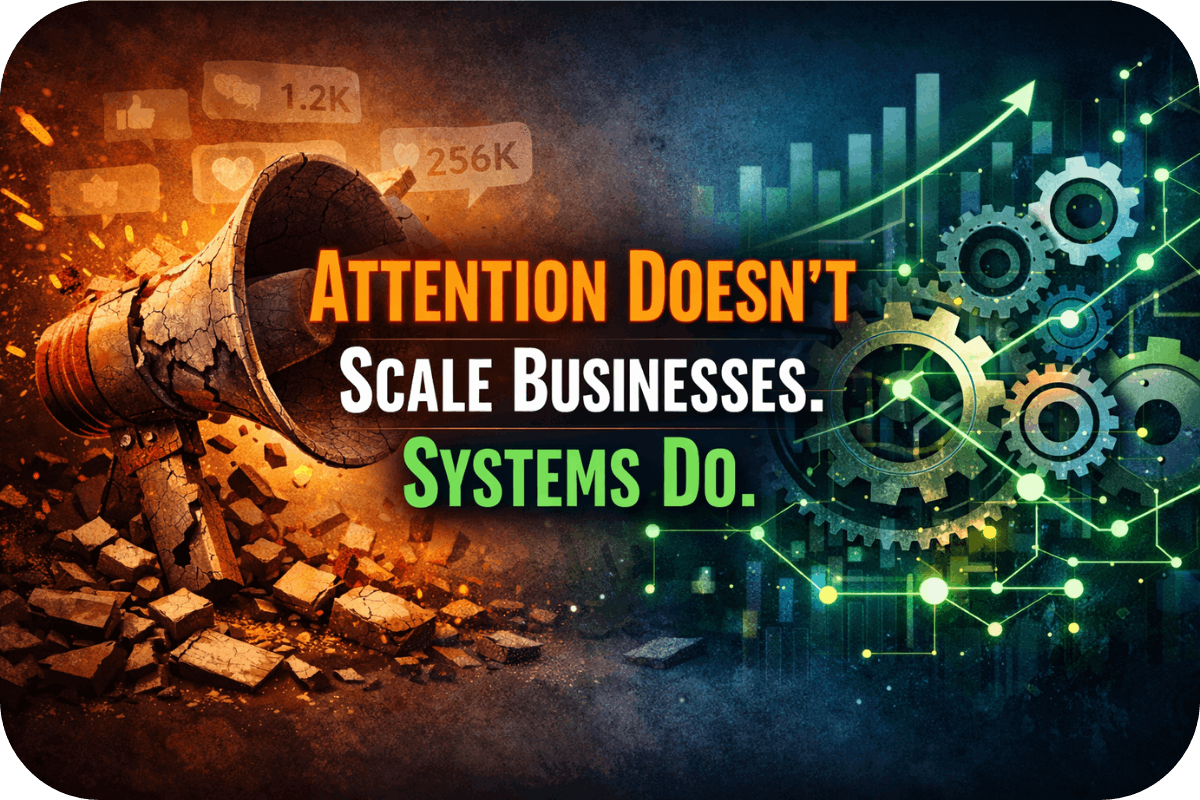
Most creators chase visibility and call it growth. This article explains why attention creates momentum, but only systems create businesses that actually scale.
Most modern growth advice starts in the same place: get visible first. Build an audience. Accumulate followers. Let attention lead the way.
That framing feels logical, especially in creator-driven markets where reach is public and metrics are easy to track. Visibility becomes the stand-in for progress. Attention is treated as the engine of growth rather than the raw material it’s built from.
But businesses that scale reliably don’t operate this way. They don’t depend on constant exposure to survive. They’re structured to convert attention into something owned, repeatable, and durable.
That’s the distinction most conversations skip. Followers can create momentum, but systems are what turn momentum into continuity.
Once attention is separated from ownership, the limits of follower-first growth become hard to ignore.
Followers are often treated as proof of progress. They’re visible, countable, and socially reinforced. But what they actually measure is reach, not control.
A follower indicates that attention passed by at some point. It doesn’t guarantee it will return. Platforms decide when and how that attention is delivered, which means distribution is conditional, not owned. Reach can increase while predictability stays flat.
This is why audience size often feels powerful without producing leverage. Leverage comes from consistency in how attention is captured and converted. Followers don’t create that on their own. They fluctuate with algorithms, trends, and timing, none of which are controlled by the business relying on them.
This distinction becomes clearer when reach is separated from outcomes. Visibility can rise while income, learning, and continuity remain unchanged. That’s why audience size often has nothing to do with creator income, even when the numbers look impressive.
If followers don’t create leverage, something else has to.
Attention by itself is unstable. It arrives, spikes, and disappears on someone else’s schedule. Funnels exist to change that relationship.
A funnel isn’t a marketing trick or a tool stack. It’s a structural pathway that captures intent and directs it into something owned. When funnels are described as systems rather than tactics, they’re referring to what a creator funnel actually is. Instead of relying on attention to return, the structure creates continuity by design.
This is why ownership matters. Platforms can change distribution overnight, but a system that captures and routes attention doesn’t reset every time reach fluctuates. The surface numbers may rise and fall, but the underlying structure keeps working.
When funnels are treated as systems rather than tactics, they stop being about persuasion and start being about predictability. They make outcomes repeatable even when visibility is inconsistent.
This is why two creators with the same reach end up in very different positions.
No. Followers are one way to generate visibility, but they aren’t a requirement for building a business. Many profitable businesses grow through search traffic, referrals, email, partnerships, or direct intent, channels where people are already looking to solve a problem. Followers create reach. Stability comes from owning the path between interest and action.
An audience measures attention. A funnel structures behavior. Audiences show who is watching. Funnels define what happens next. Without a funnel, attention resets every time the platform does. With one, interest moves into something owned, repeatable, and measurable.
Because following is a low-commitment action. It signals interest, not intent. Most followers are consuming, not deciding. Funnels are built around decision points, not content consumption. They reduce friction, clarify value, and guide action. Followers don’t fail to convert because they’re uninterested. They fail because nothing is designed to help them decide.

The Backdoor Blueprint is the 12-page starter guide to the Infinite Hustle Lab system. It's the exact strategy we use to build lean, scalable digital income streams.
Trusted by 500+ solopreneurs building real systems around the world.

The AI Income Stack gives you five proven ways to turn tools into income — including self-publishing, affiliate funnels, and automation-based product sales.
Perfect for anyone starting from scratch who wants to build smarter.

This is the master strategy guide for monetizing automation — without gimmicks or hype. If you want to build real income using smart tools and scalable systems, this is where to start.
Influencer-first growth models work best in the early stages, when novelty is high and friction is low. Reach expands quickly, engagement feels validating, and monetization appears possible. But the structure underneath never changes.
That’s because reach in these models is rented, not owned. Distribution depends on platforms that can throttle visibility without warning. When growth relies on continued exposure, every algorithm shift becomes a reset instead of a variable the business can absorb.
This is why monetization stays fragile. Income rises when attention spikes and stalls when it fades. Nothing compounds because nothing is retained. Each cycle starts from scratch, even when effort remains consistent.
Early momentum can hide this problem for a while. The first win creates confidence, and advice that worked once feels repeatable. But as conditions change, the absence of structure becomes visible. What looked like growth turns out to be timing.
This pattern mirrors why most growth advice doesn’t scale past the first win. Early success happens in low-resistance environments. Scale introduces friction, and systems that never accounted for it begin to break.
The issue isn’t content or effort. It’s what growth is expected to do.
Attention moves in spikes. It rises quickly, fades just as fast, and leaves no memory behind. Systems behave differently.
When a system is in place, learning accumulates. Each interaction feeds back into the structure itself, making future outcomes more predictable. Growth doesn’t restart every time visibility drops. It builds on what already exists.
This is the difference between momentum and compounding. Momentum depends on continued exposure. Compounding depends on retained structure. One feels exciting. The other quietly strengthens over time.
Businesses that rely on attention are forced to chase the next surge. Businesses built on systems improve even when attention fluctuates, because the work carries forward instead of resetting.
This is the difference between momentum and durability.
Across different industries and models, businesses that scale reliably tend to share the same underlying traits. They are built around systems, not personalities. Outcomes don’t depend on constant presence or performance.
These businesses prioritize owned pathways over borrowed reach. Attention still matters, but it’s routed through structures designed to persist beyond any single platform or surge of visibility.
There’s no confusion about how value moves through the system. The path from attention to action is clear, even when nothing is being pushed. People understand what happens next and why it exists.
This combination doesn’t create hype. It creates durability. And durability, not visibility, is what allows growth to compound.
The Backdoor Blueprint is the 12-page starter guide to the Infinite Hustle Lab system. It's the exact strategy we use to build lean, scalable digital income streams.
Trusted by 500+ solopreneurs building real systems around the world.
The AI Income Stack gives you five proven ways to turn tools into income — including self-publishing, affiliate funnels, and automation-based product sales.
Perfect for anyone starting from scratch who wants to build smarter.
This is the master strategy guide for monetizing automation — without gimmicks or hype. If you want to build real income using smart tools and scalable systems, this is where to start.