Build Real Income with AI-Powered Leverage
Build Real Income with AI-Powered Leverage
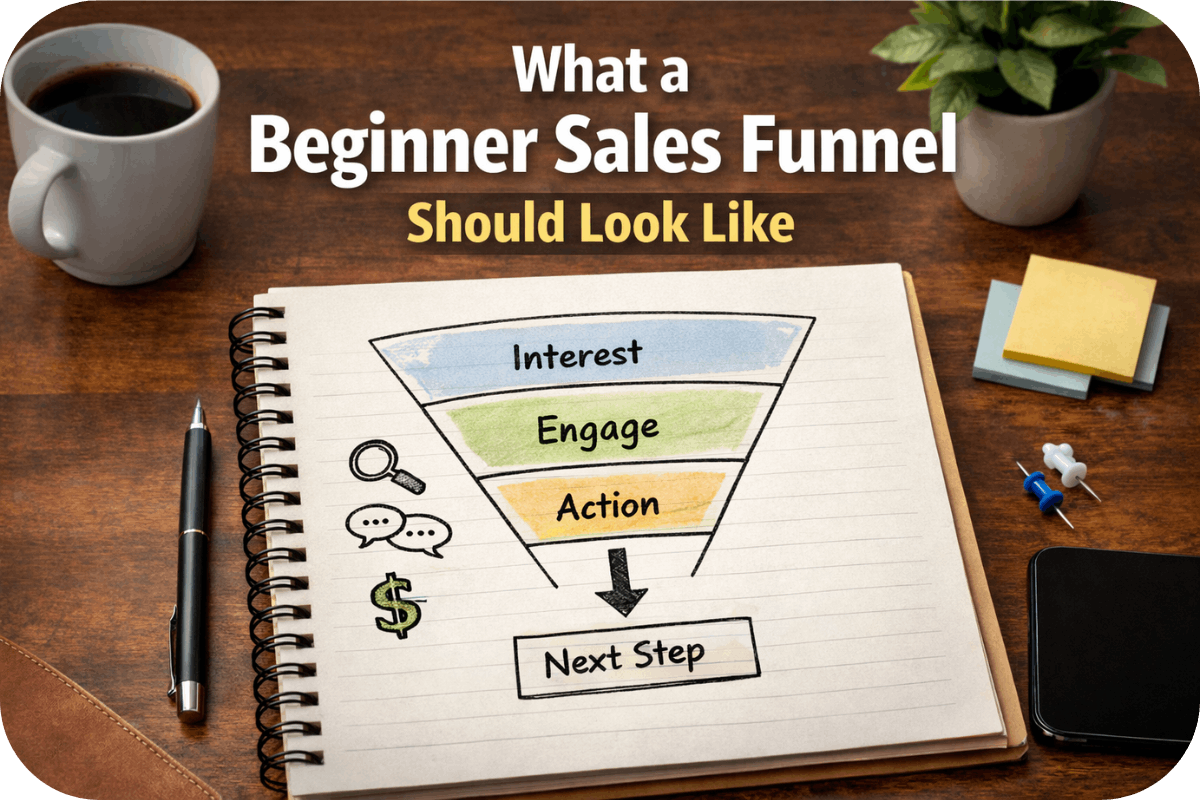
A beginner-friendly breakdown of what a modern sales funnel should look like, focusing on clarity, structure, and momentum rather than ads, tools, or complexity.
Funnels get overcomplicated fast.
Most beginners hear the word funnel and immediately picture software, ads, email sequences, and dashboards they don’t understand yet. That fear usually pushes them in one of two directions: they either avoid funnels completely, or they overbuild one before they’ve sold anything.
Neither works.
In practice, beginners don’t struggle because funnels are too advanced. They struggle because funnels are framed as selling machines instead of what they actually are: guidance structures. A funnel isn’t about persuasion, pressure, or tech stacks. It’s about helping someone move from interest to a clear next step without confusion.
I’ve watched new creators waste weeks wiring tools together, and I’ve watched others make sales with nothing more than a simple page and a clear path forward. The difference was never the platform. It was whether the structure made sense to a human on the other side.
When you strip away the software and the buzzwords, a beginner funnel becomes much simpler and much more useful.
And that’s where we need to start — not with tools, ads, or automation, but with the structure a beginner funnel is actually supposed to provide.
Beginner funnels don’t feel overwhelming because they’re complicated, it's because beginners are usually looking at the wrong examples.
Most funnel advice online is built for creators who already have traffic, products, and an audience. When beginners try to copy those setups, they inherit layers they don’t need yet: multiple pages, long email sequences, paid tools, and tracking they can’t interpret. The result isn’t progress. It’s paralysis.
This is the same trap creators fall into when they chase growth before structure. Funnels over followers exist for a reason. An audience doesn’t fix confusion, and more exposure won’t save a funnel that doesn’t make sense at a basic level.
The feeling of being overwhelmed isn’t a skill issue. It’s a mismatch between the funnel you’re trying to build and the stage you’re actually in.
Once you see that, the problem shifts. The question stops being “How do I build a funnel?” and becomes “What does a funnel need to do right now?”
That’s the pivot most beginners never make and it’s what simplifies everything that comes next.
A funnel isn’t a sales machine. It’s a decision guide.
At the beginner level, the job of a funnel isn’t to persuade, pressure, or optimize conversions. Its job is to help someone move from confusion to clarity without friction. That’s it.
Most people arrive with a vague problem, scattered attention, and low trust. A working funnel doesn’t try to fix all of that at once. It narrows the focus. It answers one question at a time and removes unnecessary choices along the way.
This is why beginners struggle when they treat funnels like performance tools instead of guidance systems. When you aim for persuasion before clarity, everything feels heavy. Too many messages. Too many options. Too much explanation.
A good beginner funnel feels quiet. It doesn’t push. It points.
Once you understand that, the structure stops being intimidating. It becomes obvious. Because if the funnel’s job is to guide decisions, the structure simply reflects the order those decisions need to happen in.
That’s where the shape of the funnel starts to matter, not because of tools or tactics, but because of sequence.
Beginner funnels don’t fail because they’re missing complexity. They fail because they try to do too much, too early.
At its core, a funnel only needs three parts to work. Not pages. Not tools. Not automations. Just three functional roles that move someone forward.
Entry is how someone finds you.
This is the moment attention begins. It might be a post, an article, a comment, or a simple link. It doesn’t need to be optimized. It just needs to exist where the right people already are.
Trust is why they stay.
This is where clarity replaces skepticism. You explain the problem they’re facing in a way that feels accurate, grounded, and human. No persuasion. No hype. Just alignment. This is the part most beginners skip, even though it’s what makes everything else work.
Direction is what they do next.
A funnel without direction stalls. A working funnel gives one obvious next step. Not five options. Not a menu. One clear path forward that matches where the person is right now.
This is the same flow explained in more detail when breaking down what a creator funnel actually is, but at the beginner level, it doesn’t need to be dressed up or expanded.
The simplicity here isn’t a limitation. It’s intentional.
When funnels feel overwhelming, it’s usually because these three parts get blurred together or multiplied unnecessarily. Once they’re separated and sequenced correctly, the funnel stops feeling like a system you have to manage and starts feeling like a structure that carries the work for you.
And that’s where most beginners finally hit the real problem, not knowing what to remove when building their first funnel.
The simplest funnel has three parts: a way for someone to find you, a place where trust is built, and a clear next step. It doesn’t require multiple pages or automation. If a person can understand what you offer and what to do next, the funnel is already working.
No. Funnels are not built after you have an audience. They’re built so early traffic has somewhere to go. Even small amounts of attention can convert when there’s structure guiding the next step.
Yes. Funnels don’t rely on ads to function. Ads only increase volume. The funnel itself is responsible for clarity, trust, and direction. If it doesn’t work without ads, ads won’t fix it.

The Backdoor Blueprint is the 12-page starter guide to the Infinite Hustle Lab system. It's the exact strategy we use to build lean, scalable digital income streams.
Trusted by 500+ solopreneurs building real systems around the world.

The AI Income Stack gives you five proven ways to turn tools into income — including self-publishing, affiliate funnels, and automation-based product sales.
Perfect for anyone starting from scratch who wants to build smarter.

This is the master strategy guide for monetizing automation — without gimmicks or hype. If you want to build real income using smart tools and scalable systems, this is where to start.
Most beginner funnels don’t fail because something is missing. They fail because complexity shows up before it’s earned or needed.
Early on, beginners start stacking pieces that only make sense later. Email sequences get built before intent exists. Multiple offers appear before trust is established. Extra pages are added to look “complete” instead of helping someone move forward.
What begins as a simple path quickly turns into a maze no one actually wanted to walk through.
This overbuilding usually comes from copying advanced setups without understanding the sequence behind them. Real funnels are built in order, not all at once. Attention comes first. Trust follows. Direction comes last. When those stages are reversed or stacked together, friction creeps in.
You see this most clearly when people focus on building full sales funnel email sequences before the funnel itself is doing its job. Messages pile up, but there’s no clear point where a reader is actually ready to act.
Early on, structure should reduce decisions, not create them. Each additional layer should exist to support movement, not showcase effort.
That’s why simpler funnels often convert better at the beginning. Fewer steps mean fewer places for someone to drop off.
And once you see where overbuilding sneaks in, it becomes much easier to strip a funnel down to what actually matters.
Momentum doesn’t come from volume. It comes from continuity.
A beginner funnel creates momentum by doing one simple thing well: it connects small actions so they build on each other instead of resetting every time. One piece of attention leads somewhere. One decision creates the next opportunity. Nothing is wasted.
When a funnel is simple and intentional, even small amounts of traffic start to matter. A handful of readers become a few engaged subscribers. A few subscribers become early buyers. Progress shows up quietly, not all at once.
This is why small traffic can still produce meaningful results. It’s not about squeezing more out of each person. It’s about making sure effort compounds instead of disappearing. The funnel holds the context so each step feels natural rather than forced.
Beginners often underestimate this because momentum doesn’t look dramatic at first. There are no spikes, no overnight changes. Just fewer dead ends and more follow-through week after week.
And once momentum exists, the funnel stops feeling like something you have to “work on” and starts feeling like something that supports the work you’re already doing.
That’s when its real value shows up, not just in the short term, but in how it continues to be useful as everything else grows.
A beginner funnel isn’t a standalone project. It’s a foundation.
On its own, a simple funnel helps people move from interest to action. Inside a creator system, it does something more important: it creates alignment. It gives everything else a place to point toward.
This is where funnels start to connect with the rest of the system. Content has direction. Offers make sense. Traffic isn’t just collected, it’s guided. Even small improvements begin to stack because the structure underneath stays consistent.
As creators grow, the funnel doesn’t get replaced. It gets reinforced. New layers get added only when the base is already working. That’s how a beginner setup evolves into a sustainable system instead of collapsing under its own weight.
Seen this way, funnels stop feeling like a marketing trick and start functioning as infrastructure. Quiet, reliable, and supportive of whatever comes next.
And once the system is in place, the next step isn’t more complexity. It’s learning how to build on top of what already works.
If funnels still feel confusing, that’s usually a sign you’re missing orientation, not effort.
The Backdoor Blueprint is where most creators should start. It lays out how the pieces fit together before you worry about tools, pages, or traffic. No setups. No tactics. Just clarity on what to build first and why.
Once direction exists, the AI Income Stack lays out five proven income models you can build. It shows how simple funnels connect to real revenue paths so effort compounds instead of stalling.
Structure comes first. Income models come next. Everything else builds on that.
The Backdoor Blueprint is the 12-page starter guide to the Infinite Hustle Lab system. It's the exact strategy we use to build lean, scalable digital income streams.
Trusted by 500+ solopreneurs building real systems around the world.
The AI Income Stack gives you five proven ways to turn tools into income — including self-publishing, affiliate funnels, and automation-based product sales.
Perfect for anyone starting from scratch who wants to build smarter.
This is the master strategy guide for monetizing automation — without gimmicks or hype. If you want to build real income using smart tools and scalable systems, this is where to start.