Build Real Income with AI-Powered Leverage
Build Real Income with AI-Powered Leverage
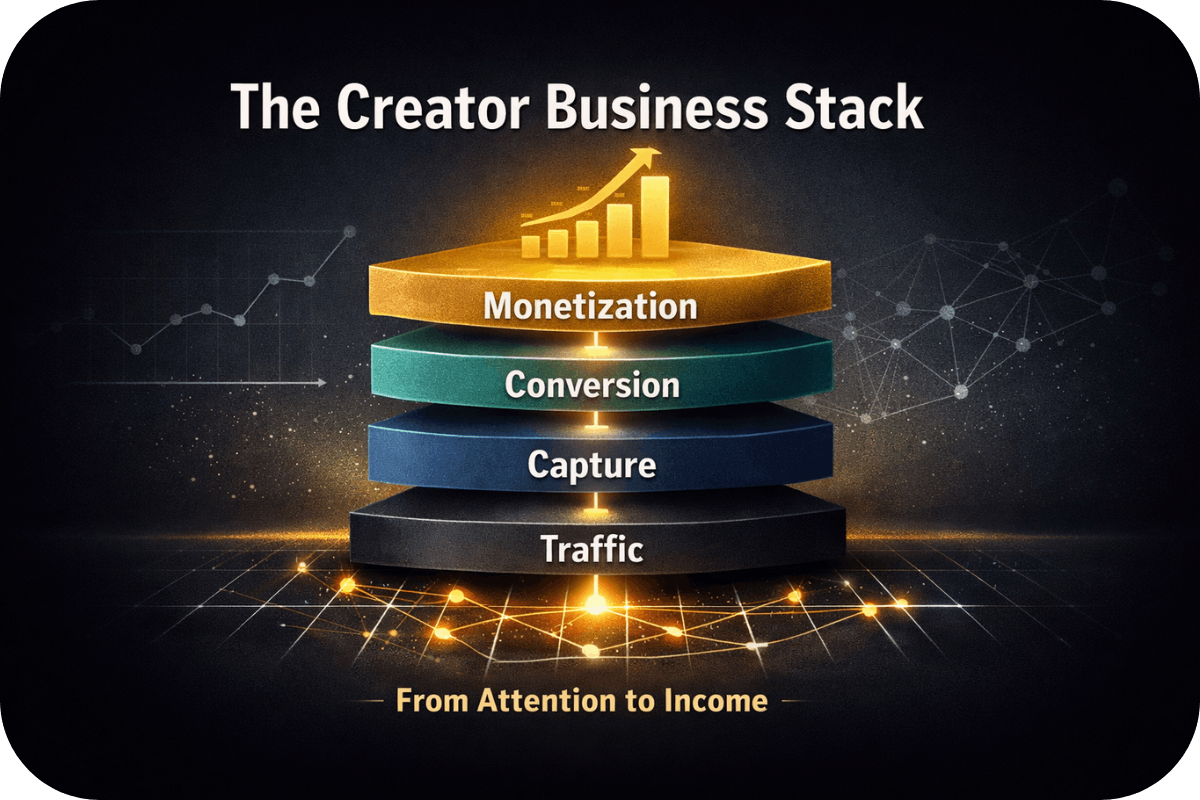
Most creator businesses don’t fail from lack of effort. They fail because the pieces never work together. This article breaks down the Creator Business Stack — the simple structure behind online businesses that compound instead of resetting.
Most creators aren’t stuck because they lack ideas, effort, or talent. They’re stuck because nothing they’re doing is connected.
While working with different creators inside Infinite Hustle Lab, I see the same pattern show up again and again. People publish consistently, test offers, grow small audiences, and follow solid advice, but income still feels fragile. Progress depends on being present, pushing constantly, and hoping momentum doesn’t drop.
That isn’t a motivation problem. It’s a structural one.
Profitable creator businesses aren’t built from isolated moves. They’re built from layers that support each other. When those layers exist, effort compounds. When they don’t, progress resets no matter how hard someone works.
The Creator Business Stack is a way to see what’s missing. It’s not a set of steps to follow, instead it's the framework of the underlying system every profitable online business relies on, whether the creator realizes it or not.
Once the stack is visible, a lot of confusion disappears.
Most creator businesses don’t fail because the work is bad. They fail because the work never connects.
Creators tend to build in fragments. A YouTube channel here. A newsletter there. A product launched in isolation. Each piece can look productive on its own, but none of it supports anything else. When one channel slows down, income slows with it. When motivation dips, momentum disappears. Nothing carries the weight.
This is why output-heavy strategies feel exhausting over time. Content goes out, effort goes up, but results stay fragile. The business depends on whatever was worked on most recently, instead of being supported by something underneath it. As explored in Content Is Not a Business Model, producing more doesn’t solve the structural problem, it often hides it.
Without a stack, every tactic has to perform perfectly on its own. There’s no reinforcement. No compounding. No safety net. That’s why stalls in engagement feel sudden and income collapses feel confusing. The business was never designed to hold itself together.
If collapse is the symptom, the stack will explain why it keeps happening.
A Creator Business Stack isn’t a list of tools. It’s not a tech setup, a funnel diagram, or a screenshot of software stitched together to look impressive.
The stack is the order of layers that move value forward.
Each layer exists for a specific reason, and more importantly, each layer supports the one above it. Attention feeds something owned. Ownership feeds conversion. Conversion feeds income. Income feeds stability. When those layers are out of order or missing, growth feels chaotic even when effort is real.
This is where a lot of confusion comes from. Creators compare tool choices instead of structure. They argue platforms instead of flow. But tools change constantly. The structure doesn’t.
This becomes obvious after watching the same pattern repeat across different attempts. Different channels. Different products. Different levels of effort. The setups that worked weren’t cleaner or more advanced. They were ordered. Each piece existed to support something else.
That’s why two creators can use completely different tools and still build similar results. The stack is structural, not technical. It doesn’t care whether you use Webflow or WordPress, ConvertKit or something else. It only cares that value moves in one direction and doesn’t leak out along the way.
When the stack is missing, everything feels harder than it should. When it’s in place, growth starts to make sense.
Once the stack is visible, confusion around growth starts to disappear.
Attention is how people first discover you. That’s it.
It creates awareness, curiosity, and occasionally momentum, but it does not create income on its own. Treating attention as the engine instead of the entry point is where most creator businesses quietly break.
Platforms are designed to surface content, not to preserve progress. Attention and reach spikes, then fades. Algorithms shift. Feeds reset. What worked last month stops working without warning. That volatility isn’t a bug, it’s the system doing exactly what it’s built to do.
This is why publishing alone never stabilizes income. Output can increase while revenue stays flat because attention doesn’t retain value by itself. It doesn’t remember past work. It doesn’t compound effort. It simply passes through, forcing creators to start over each time.
The same pattern shows up in blogging. As covered in Can a Blog Still Make Money, content still works, but only as a discovery layer. Posts bring people in, not money out. When a blog is treated as the business instead of the doorway, results plateau fast.
Attention creates opportunity. It does not carry progress forward.
Attention only matters if it has somewhere to go.
Attention creates possibility. Intent creates pressure.
Income doesn’t form when someone notices your work. It forms when someone is already trying to solve something and encounters a clear path forward. That moment is quieter than most creators expect, but it’s where monetization actually starts.
This is why small audiences often outperform large ones early. Intent doesn’t scale with visibility. It concentrates around specific problems, timelines, and decisions. A hundred people actively searching for an answer will always be more valuable than ten thousand casually consuming content.
Across creator businesses that move early, the pattern is consistent: income appears before visibility. Not because the work is better marketed, but because it shows up when the buyer is already leaning forward. This is the dynamic explored in How Creators Build Income Without a Big Audience, where earnings form around intent long before reach catches up.
The mistake most creators make is assuming income arrives after growth. In reality, growth amplifies what already converts. It doesn’t create conversion on its own.
Intent creates pressure, but only if it’s captured.
Buyer intent means someone is already trying to solve a problem, not just consuming information. They’re searching, comparing, or deciding. This is the difference between passive attention and active demand.
Attention is temporary. It passes through unless there’s a clear next step. Without a system to capture and direct it, even large spikes in traffic disappear without compounding.
Interest is curiosity. Intent is readiness. Interest consumes content; intent looks for resolution. Businesses are built by serving intent, not maximizing interest alone.

The Backdoor Blueprint is the 12-page starter guide to the Infinite Hustle Lab system. It's the exact strategy we use to build lean, scalable digital income streams.
Trusted by 500+ solopreneurs building real systems around the world.

The AI Income Stack gives you five proven ways to turn tools into income — including self-publishing, affiliate funnels, and automation-based product sales.
Perfect for anyone starting from scratch who wants to build smarter.

This is the master strategy guide for monetizing automation — without gimmicks or hype. If you want to build real income using smart tools and scalable systems, this is where to start.
Attention is fleeting by default. Someone sees your work, nods along, then disappears. Capture is what changes that. It gives interest a place to land instead of letting it pass through.
Capture doesn’t mean trapping people or forcing decisions. It means creating a way back. A path you control where interest can remain reachable after the moment passes. Without that path, every small win resets. Every click, view, or conversation starts from zero again.
This is the first layer in the stack that isn’t borrowed. Platforms decide who sees you. Algorithms decide when you’re shown. But capture creates continuity independent of those shifts. It’s the difference between hoping attention returns and designing for it to come back on purpose.
This is why creators with similar reach end up in very different positions. One relies on rented visibility. The other builds controlled paths that persist even when distribution changes. That distinction sits at the center of Funnels Over Followers, not as a tactic, but as a structural advantage.
Without capture, effort evaporates. With it, progress can finally stack.
Once interest can return, income can finally form.
An offer isn’t persuasion. It’s clarification.
Most creators think conversion fails because they didn’t push hard enough. In reality, conversion fails when the decision is unclear. When someone can’t immediately tell what they’re getting, why it matters, or whether it’s for them, they don’t say no, they hesitate. And hesitation kills momentum.
That’s why hype rarely fixes sales. It increases noise without reducing friction.
Strong offers do the opposite. They make the decision feel obvious. The scope is tight. The outcome is clear. The next step requires minimal interpretation. This is why many digital products fail before they ever sell: the structure exists, but the offer asks too much cognitive work from the buyer.
Small, obvious offers outperform vague, ambitious ones because they’re easier to trust. Early buyers aren’t looking for everything. They’re looking for certainty. This is also why your first digital product should be small, not because scale is bad, but because clarity is fragile early on.
At this layer of the stack, offers aren’t about maximizing revenue. They’re about validating that the system underneath actually works. A single clean decision tells you more than a thousand impressions ever could.
But offers alone don’t create stability.
This is the layer where things start to feel different.
Up to this point, you can be doing real work and still feel like you’re dragging everything uphill. Leverage is what changes that. It’s the moment progress stops resetting and starts carrying forward on its own.
Leverage isn’t about working less. It’s about not starting from zero every time. Systems retain what you learn. They remember what worked, what didn’t, and what needs adjusting. Each cycle improves the structure itself, not just the immediate result. That’s why consistency alone doesn’t build a digital product business. Repetition without retention just creates motion.
When leverage exists, effort becomes an input, not the engine. You still show up, but the system does more of the heavy lifting than you do. That’s also why online income feels harder than it should be when this layer is missing. Everything depends on you, all the time. Taking a break feels risky. Momentum feels fragile.
Leverage removes that weight. Not overnight. But gradually, predictably, and measurably. Progress stacks. Adjustments get easier. Results stop evaporating between sessions.
This is the layer most side hustles never reach, not because the people running them aren’t working hard enough, but because nothing was built to carry the work forward.
Once leverage is in place, the stack stops feeling theoretical and starts behaving like a business.
The stack only works when the layers support each other. Remove one, and everything above it becomes fragile.
Attention without a way for interest to return turns into noise. You get views, reactions, and short bursts of momentum, but nothing carries forward. Every spike fades, and the next push has to start from scratch.
Capture without a clear offer creates stagnation. Interest exists, but it has nowhere meaningful to go. People circle, hesitate, and drift away because there’s no obvious decision to make. Progress slows, not because demand disappeared, but because the path forward was never defined.
Offers without leverage lead straight to burnout. You can sell, even repeatedly, but each win depends on another push. Nothing compounds. Income feels like a heavy lift because the effort required never lets up.
None of these failures are dramatic. That’s what makes them hard to diagnose. The system looks busy and almost working.
That’s why so many creators feel close… but stuck.
In practice, the stack doesn’t look the same for everyone.
The tools change. The platforms change. How the stack is built varies by skill set, audience, and constraints. But the underlying structure stays consistent. Attention still enters somewhere. Intent still has to be recognized. Interest still needs a place to land. Offers still need to be clear. Leverage still has to exist for progress to carry forward.
That’s why copying someone else’s setup rarely works. You can borrow tools, but you can’t borrow alignment. What matters isn’t what someone is using. It’s whether each layer knows what it’s supporting.
When the stack is aligned, outcomes stabilize. Not because effort disappears, but because effort finally compounds. Work stops evaporating between sessions. Adjustments get easier. Growth becomes predictable instead of fragile.
This is also why the model holds up across very different creator businesses. Different surfaces. Same spine.
When the stack is aligned, growth stops feeling fragile.
By the time creators reach this point, the issue is rarely motivation or effort, it’s organization.
The AI Money Machine Toolkit exists to support stack thinking, not to hand over a finished system or automate results. It’s designed for creators who already understand that income doesn’t come from tools, posts, or hacks, but from how those pieces are ordered and connected.
It doesn’t promise shortcuts. It doesn’t replace execution. And it doesn’t turn work into money by itself.
What it does is give structure to effort that already exists.
The AI Money Machine is a strategy playbook. It doesn't provide done-for-you systems, technical walkthroughs, or guaranteed outcomes.
For beginning creators who are ready to stop guessing and start building deliberately, it’s a way to organize momentum into something that can actually last.
The Backdoor Blueprint is the 12-page starter guide to the Infinite Hustle Lab system. It's the exact strategy we use to build lean, scalable digital income streams.
Trusted by 500+ solopreneurs building real systems around the world.
The AI Income Stack gives you five proven ways to turn tools into income — including self-publishing, affiliate funnels, and automation-based product sales.
Perfect for anyone starting from scratch who wants to build smarter.
This is the master strategy guide for monetizing automation — without gimmicks or hype. If you want to build real income using smart tools and scalable systems, this is where to start.